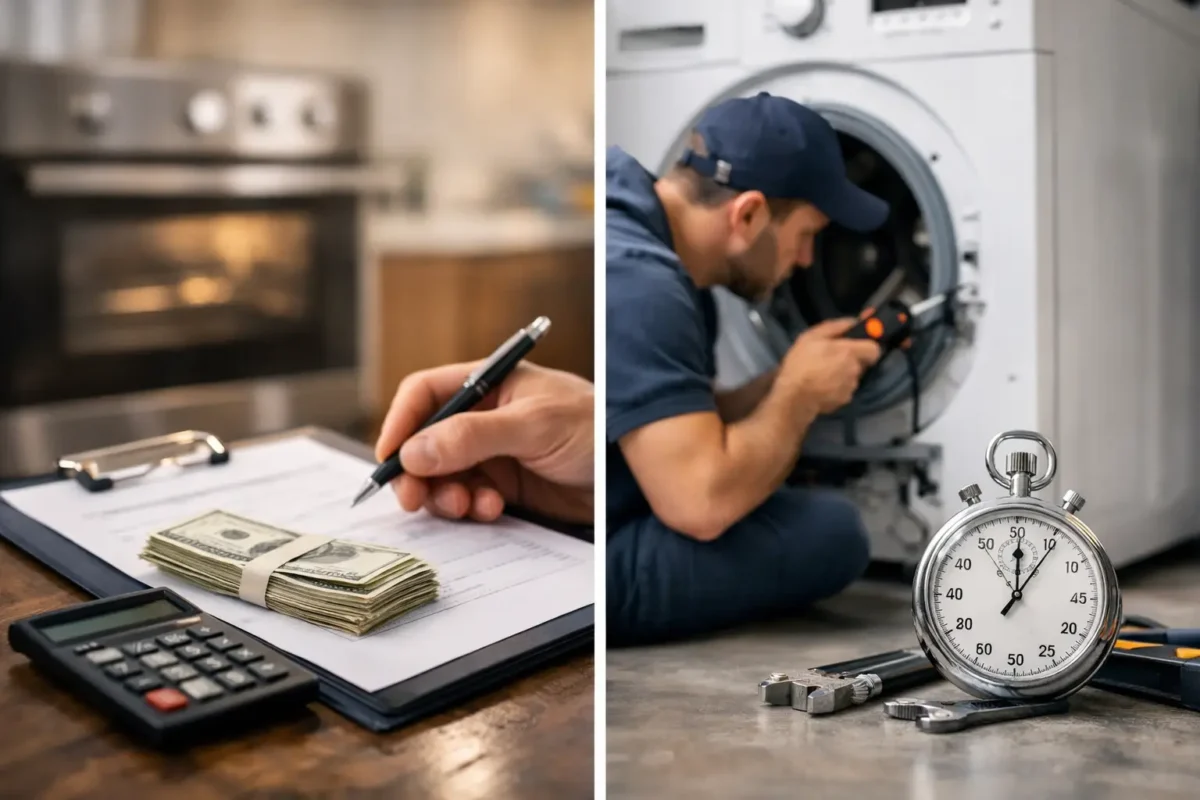
A refrigerator that stops cooling or a washer that will not drain creates enough stress without wondering whether the repair bill will keep climbing while a technician works. When comparing appliance repair flat rate vs hourly pricing, the biggest difference is simple: flat-rate pricing tells you the labor cost for the repair before work begins, while hourly pricing ties that cost to time on the job.
For Tucson homeowners, renters, landlords, and property managers, clear pricing matters. You need the appliance working again, but you also need to know whether repairing it makes financial sense. Here is how each pricing model works and why job-based pricing is often the easier choice for an in-home appliance repair.
What Flat-Rate Appliance Repair Pricing Means
Flat-rate pricing, sometimes called job-based pricing, assigns a set labor price to a specific repair. After the technician diagnoses the problem, you receive the cost to complete that repair. The price is based on the work required, not on how many minutes the technician spends in your kitchen, laundry room, or garage.
For example, a dryer may need a failed heating component replaced, or a dishwasher may need a new drain pump. The labor charge for that repair is quoted as a job. If the technician is efficient, experienced, and has the right part available, you benefit from a faster completed repair without paying extra simply because the work took less or more time than expected.
A flat rate does not mean every repair has the same price. Replacing a simple switch is different from repairing a refrigerator cooling issue. The appliance type, failed component, accessibility, brand, and repair complexity all affect the quote. What it does mean is that once the issue is identified and approved, the labor price is clear.
Parts are commonly separate from labor because part costs vary by model and availability. A trustworthy repair company should explain the diagnosed issue, identify the recommended repair, and provide the full expected cost before moving forward.
How Hourly Appliance Repair Billing Works
With hourly billing, a company charges for the technician’s time. There may be a minimum charge for the first hour, then additional charges in set increments. In some cases, travel time, diagnostic time, time spent locating a part, or a return visit may also affect the final bill.
Hourly pricing can work reasonably well when a job is truly unpredictable. An older appliance with multiple problems, difficult wiring concerns, or an intermittent issue may require more investigation than a routine repair. It can also be useful when a customer specifically wants a technician to handle several small tasks during one visit.
The downside is uncertainty. A repair that appears straightforward can take longer if the appliance is hard to access, corrosion has affected a component, or the technician uncovers another failed part. Even when everyone is acting in good faith, the final amount can be hard to predict at the start of the appointment.
That uncertainty is especially frustrating when a household depends on the appliance. If your refrigerator is warm, your oven will not heat, or laundry is piling up, you want a direct answer about the repair plan and cost, not a running clock.
Appliance Repair Flat Rate vs Hourly: The Real Difference
The choice is not only about the dollar amount. It is about who carries the risk of a repair taking longer than expected.
With hourly billing, the customer generally carries more of that risk. A technician may need extra time to disassemble the appliance, test components, or complete a difficult installation, and the bill rises with the time involved. You may receive a rough estimate, but the final number can still change.
With a flat rate, the repair company carries more responsibility for accurately diagnosing the issue and completing the job efficiently. The technician still needs access to the appliance and may discover a separate, previously hidden problem. But for the approved repair, you know the labor cost before the work starts.
For most common home appliance problems, flat-rate pricing is easier to understand and budget for. It also encourages a clear conversation upfront: What is wrong? What will it take to fix it? What will the repair cost? Is repair the better value than replacement?
Why Experience Matters More With a Flat Rate
A flat rate is only as fair as the diagnosis behind it. A technician must identify the actual cause of the problem, not just replace a part that seems likely to fail. An oven that will not heat may have a heating element issue, but it could also involve a control, sensor, wiring connection, or power supply concern. The right repair starts with testing.
Experienced local technicians help protect customers from unnecessary parts and repeat visits. They know common problems across major brands, including GE, LG, Samsung, Whirlpool, Maytag, Bosch, Frigidaire, Kenmore, and Amana. They also arrive prepared to complete many repairs on the first visit when the needed parts are available.
This is one reason stocked service vehicles matter. A lower quote is not very helpful if a company cannot return for a week with the part needed to finish the job. Fast diagnosis, clear pricing, and prepared technicians work together to get your household back to normal sooner.
Questions to Ask Before You Approve Any Repair
Whether a company uses flat-rate or hourly pricing, do not hesitate to ask how the bill is structured. You should know whether the service call or diagnostic fee is separate, whether it is applied to the repair, and whether the quote includes labor and parts.
Ask what happens if the technician finds an additional issue. A professional company should pause, explain the new finding, and get your approval before adding work that changes the price. You should never feel pressured into a repair you do not understand.
It is also smart to ask about the warranty. A company that stands behind completed work gives you more confidence than one that disappears as soon as payment is collected. Repair guarantees do not eliminate every possible future appliance problem, especially on older units, but they show that the company takes its workmanship seriously.
Finally, ask whether the repair is practical for your appliance’s age and condition. Sometimes a repair is the affordable, sensible choice. Other times, a major component failure on an aging appliance may make replacement worth considering. A reliable technician should give you an honest recommendation rather than pushing the most expensive option.
What Transparent Pricing Looks Like in Tucson
Transparent pricing is not just a low advertised number. It is a straightforward process that respects your time and budget. You schedule service, a technician diagnoses the issue, you receive a clear repair recommendation and price, and you decide whether to proceed.
At Axus Appliance Repair, the $45 service call fee is waived with repair, so customers are not paying a separate visit charge on top of an approved repair. Job-based pricing helps eliminate the worry of an hourly meter running while the technician works. Completed repairs are backed by a 90-day guarantee, giving customers added confidence after the appointment.
Same-day service on most calls can make a major difference when an essential appliance fails. A broken washer is inconvenient. A refrigerator that is not cooling can quickly become costly. Prompt local service helps limit the disruption and gives you a clear path forward.
When Hourly Pricing May Still Make Sense
Hourly pricing is not automatically a bad deal. If you have multiple unrelated appliances or small maintenance tasks to address in one visit, an hourly arrangement may be convenient. It can also be appropriate for work where the scope cannot reasonably be known until deeper investigation is complete.
Still, get clarity before the appointment begins. Ask about the hourly rate, minimum time charge, travel fees, diagnostic fees, and how additional time is billed. A low hourly number can look attractive until several separate charges appear on the invoice.
For a single, defined appliance repair, a flat rate is usually the more comfortable option because it puts the conversation back where it belongs: on fixing the problem well, at a price you understand.
When an appliance disrupts your day, choose a repair company that explains the issue plainly, provides the cost before work begins, and treats your home and budget with respect. That is how a repair visit should feel: straightforward, responsive, and focused on getting your appliance working again.